
Pinocchio
The ache of becoming real
80 pages · AI-illustrated · English · Tuscany, 1850s
This is not the Pinocchio you know. There is no fairy godmother, no redemption arc, no lesson learned. There is a wooden boy who wakes up one morning as a real child — forced to face the terrifying fragility of being alive.
Pages
80
Format
A4 hardcover
Language
English
Status
On Kickstarter
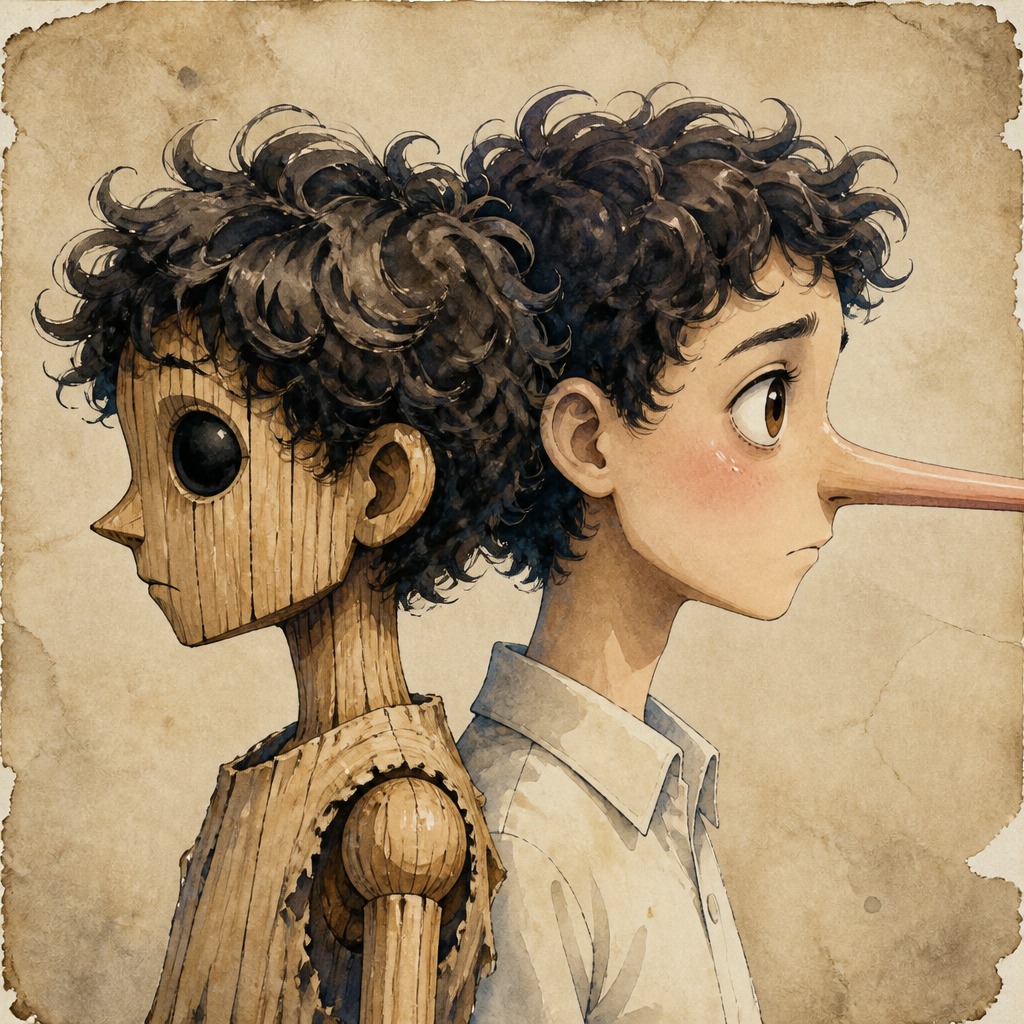
Cover illustration — Pinocchio, Ele Studios, 2026.
The Premise
In a rural Tuscan village in the 1850s, everyone is a puppet.. The villagers, the children, the old men sitting outside the tavern — all of them jointed wood, hinged at the elbows and knees, carved faces that approximate expression without quite achieving it.
It is a world that works. Nobody questions it.
Then one morning, Pinocchio wakes up and he is made of flesh.
There is no transformation sequence. No dramatic moment. He simply opens his eyes and the wood is gone. He can feel the sheets against his skin. He can feel his own heartbeat. He can feel, with an intensity that has no name and no precedent, everything.
We were told that becoming a real boy was a gift. We never considered it might be a nightmare.
The original Collodi story is, at its core, about a child who cannot control his impulses and must be disciplined into goodness. We read it differently. We read it as a story about what happens when an emotional system comes online with no warning, no preparation, and no one around who can explain what’s happening.
Pinocchio doesn’t lie. He panics. The nose grows with anxiety — a physical manifestation of an internal state he has no language for.
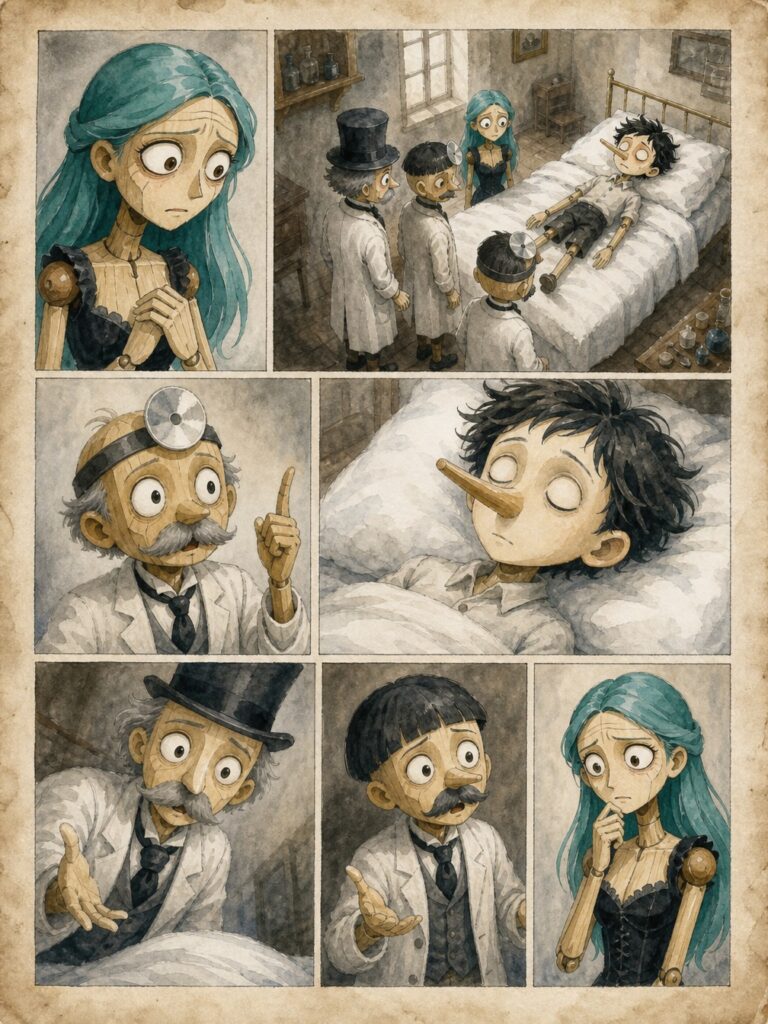
The Characters
Pinocchio
Protagonist
A wooden puppet who wakes up human. Overwhelmed by sensation, emotion, and a body he doesn’t understand. The nose grows when anxiety peaks — not when he lies. He has never lied. He doesn’t know how yet.
Geppetto
Father figure
Believes this is a miracle. He prays it is a miracle. His faith is not innocent — it is the faith of a man who needs to believe his grief had a purpose. He is not equipped to help, but he tries with everything he has.
La Fata Turchina
The dead mother
She appears in Pinocchio’s memory — or imagination — as a figure of impossible perfection. She is never prophetic. She never guides. She is a narcissistic absence that shapes everything, visible only in what she makes impossible to grieve.
Il Grillo Parlante
The voice
Not a conscience. A compulsive presence — an OCD-type internal voice that issues rules, demands compliance, punishes deviation. It lives in Pinocchio’s head and has its own logic. It is trying, in its broken way, to keep him safe.
Visual Style
The visual world of Pinocchio is built around a contradiction: something that looks ancient but feels contemporary. The setting is 19th-century Tuscany — stone walls, olive trees, candlelight. The emotional register is entirely modern.